This document contains detailed descriptions, references and exercises as background information to the WeCoRD course: ‘Open Educational Resources on Enabling Technologies in Wearable and Collaborative Robotics’. This information is complementary to the lectures, exercises and experience sessions that are organised on the occasion of WeCoRD. This document is organised in four chapters corresponding to the individual IO-modules IO1, IO2, IO3 and IO4.
The main goal of this program is to develop transdisciplinary competencies of graduate students and professionals. Students must first complete the required courses to do their projects in the winter/summer schools. Elective courses to supplement core content can be determined by respective universities. WeCoRD coursebook and related instructional videos are available at Virtual Platform page in WeCoRD website.
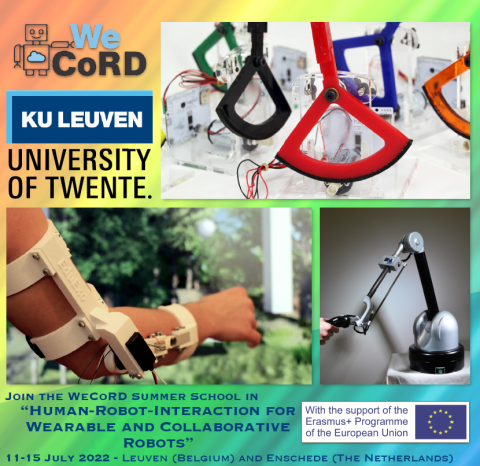
WeCoRD Summer School on “Modeling, Control, and Design of Wearable and Collaborative Robots as Systems” was held in mid-July. It was attended by 45 participants, as well as speakers from universities from all over the world. Students worked on group projects in two directions: modeling&simulation and control of an exosuit with VSA (variable stiffness drive); force control by a collaborative manipulator. As organizing commitee, we would like to express our appreciation to all the participants, and speakers of the WeCoRD Summer School.
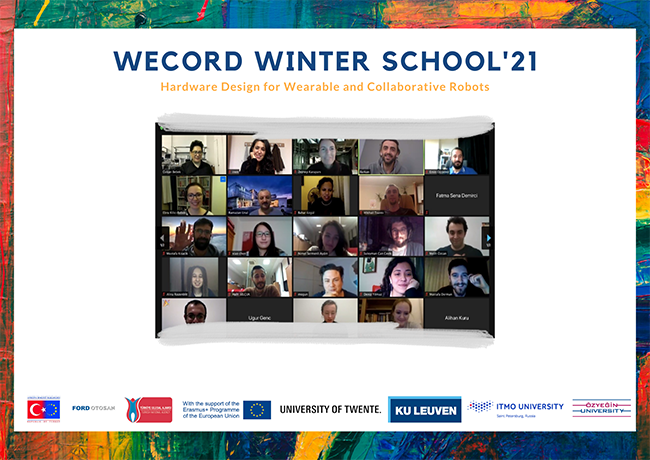
WeCoRD Winter School on “Hardware Design for Wearable and Collaborative Robots” took place last February attended by 50 students and valuable speakers from various universities around the world. Students from physiotherapy, industrial design and various engineering departments came up with solutions for situations where workers had difficulties in the factory with the case contributions of FORD Otosan. Thank you to everyone who attended and contributed to the organization of WeCoRD Winter School.
At the end of our WeCoRD Winter School, students shared their thoughts on how the program went and what they achieved. Our interactive sessions, speakers from around the world and mixed specialty teamwork were greatly appreciated and benefited all participants. The overall organization was a success!
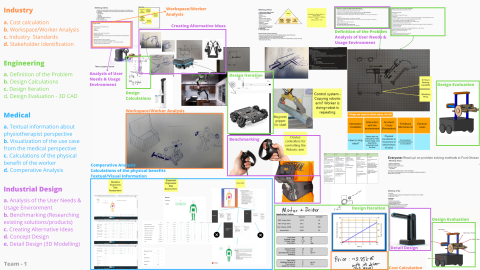
Each MURAL reflected the transdicsiplinary elabotation quality of the teams. These were examined using the criteria seen in the example. Overall, teams showed a good level of transdisciplinary elaboration quality using many details such as images, drawings and some specific calculations.